
New features in SQL Server 2025
Since SQL Server 2025 was released last November, we took some time before starting this series, but it was about time. This version is packed with new features that deserve a proper review before putting them into production. In this first post, we’ll provide an overview of the main capabilities and give you a preview of the topics we’ll explore in detail in upcoming articles.
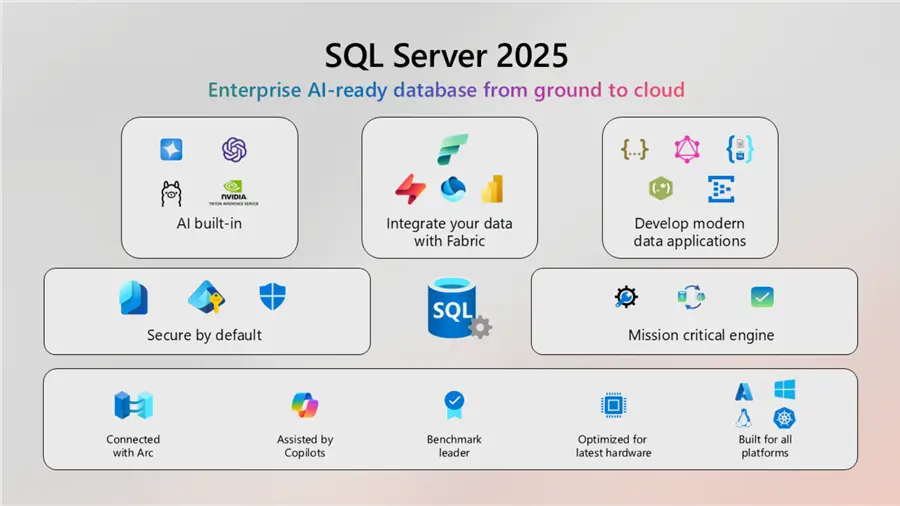
✅ Key highlights in SQL Server 2025
1. Vector Search and DiskANN
SQL Server joins the world of AI and semantic search with support for Vector Search and the DiskANN (Approximate Nearest Neighbor) algorithm.
DiskANN is an approximate vector search algorithm that operates on disk, enabling fast nearest-neighbor searches across large volumes of data. It is used in applications such as Microsoft Outlook for fast email searches, in Bing to improve search results, and in recommendation engines for e-commerce platforms.
What does this mean?
- You’ll be able to store vectors (for example, embeddings generated by language models) and perform semantic searches directly in SQL Server.
- This is key for applications such as chatbots, similarity analysis, and recommendation engines.
2. External API calls with sp_invoke_external_rest_endpoint
One of the most anticipated features: you can now invoke REST APIs directly from T-SQL.
Use cases:
- Integrate external data without leaving SQL Server.
- Consume AI services, data validation, or ERP systems from stored procedures.
Basic example:
EXEC sp_invoke_external_rest_endpoint
@method = 'GET',
@url = 'https://api.external.com/data';
3. Change Event Streaming
SQL Server 2025 introduces the ability to emit real-time change events. This means that any data modification can be published as an event, enabling integration with event-driven architectures and messaging systems such as Kafka.
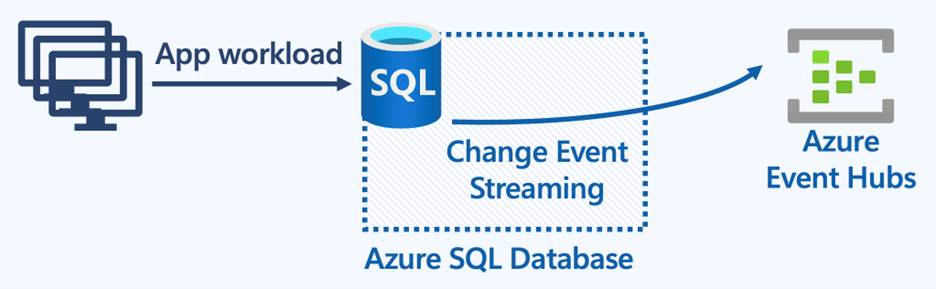
Why is this important?
- It makes it easier to build real-time data pipelines.
- It reduces the need for complex ETL processes.
- It’s ideal for microservices-based scenarios.
4. JSON improvements
JSON support continues to evolve:
- New functions for advanced manipulation.
- Optimised indexes for querying semi-structured data.
- This reduces the gap between relational and non-relational data, enabling more efficient work with hybrid data structures.
5. Optimized Locking
A new optimised locking mechanism is introduced, reducing contention in high-concurrency environments.
Benefits:
Greater scalability in systems with thousands of simultaneous transactions.
- Greater scalability in systems with thousands of simultaneous transactions.
- Lower impact on performance due to prolonged locks.
6. Improvements in Intelligent Query Processing
The evolution of IQP continues:
- Dynamic adjustments at runtime.
- Improved cardinality estimation.
- Automatic optimisation for changing execution patterns.
- This means less manual intervention and faster queries.
7. New backup compression algorithm: ZSTD
SQL Server 2025 incorpora Zstandard (ZSTD), un algoritmo moderno que ofrece:
- Higher compression ratio than previous methods.
- Faster compression and decompression, reducing backup windows.
- Ideal for environments with large data volumes.
8. Regex in SQL Server
Finally! Native support for regular expressions in T-SQL.
- Complex validations directly within queries.
- Advanced transformations without the need for CLR or external functions.
- Example:
SELECT *
FROM Customers
WHERE Email LIKE_REGEX '^[A-Za-z0-9._%+-]+@[A-Za-z0-9.-]+\.[A-Za-z]{2,};
9. New logo!
The first thing you notice when you install SQL Server 2025 is that it comes with a new logo. Much more modern, more elegant, and according to some although not officially recognised it might even make queries run faster.

What’s next?
In the upcoming posts, we will dive deeper into each of these new features with practical examples, use cases, and recommendations for implementation.
If you want to stay up to date and get the most out of SQL Server 2025, don’t miss this series!
Articles in the SQL Server 2025 Series
- Part 1: All the new features in SQL Server 2025
- Part 2: Optimized Locking in SQL Server 2025
- Part 3: New ZSTD backup compression algorithm for SQL Server 2025
- Part 4: Change Event Streaming (CES) in SQL Server 2025
- Part 5: SQL Server 2025 improves JSON performance with indexes and new functions
- Part 6: Vector Search in SQL Server 2025: VECTOR data type and DiskANN
- Part 7: How to use regular expressions (REGEX) in SQL Server 2025
- Part 8: New in Intelligent Query Processing in SQL Server 2025
- Part 9: All New Features in SQL Server Management Studio 22

Working with data technologies since 2008, my main expertise is in SQL Server but I work well as a Data Engineer in Azure Data and in all kinds of databases. Since 2015 I work at Aleson ITC, a company where I am the CTO and also a shareholder.
